SEO in 2026: How to Show Up in AI Answers
Stuffing a page with the right phrases used to be enough to rank. In 2026, search engines and AI assistants want to understand what your business actually is, what it does, and who it serves. Here is the playbook that gets you found.
 Cover Image
Quick answer: To show up in AI answers in 2026, make your business easy for a machine to identify and quote. Keep your name, address, phone, and services identical everywhere they appear. Add structured data that mirrors what the page visibly says. Open each page with a short, self-contained answer to the question a buyer asks, and make sure that text is in the server-rendered HTML.
ChatGPT, Gemini, Perplexity, and Google's AI Overviews now answer many of the questions buyers used to type into a search box. They cite a handful of sources and skip the rest. Ranking still matters, because most of these systems draw on search indexes, but the new goal is to be the source an assistant trusts enough to repeat.
What gets a business cited in AI answers?
Three things do most of the work: a consistent entity, clear facts, and passages that answer a question on their own. AI systems pull from pages they can parse and trust. If your services, service area, and business details agree across your site, your Google Business Profile, Bing Places, and directories, a model can describe you confidently. If they conflict, it hedges or picks someone else.
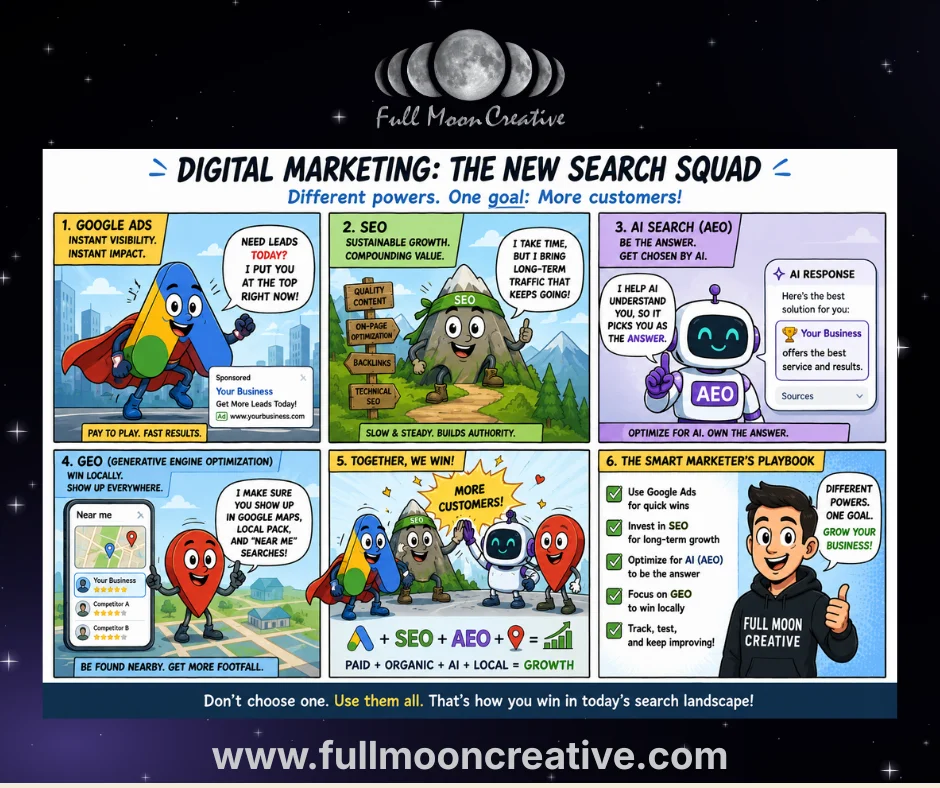
What is answer engine optimization (AEO)? Answer engine optimization is the practice of structuring content so AI assistants and answer engines can extract, trust, and cite it inside the answers they compose, not just rank it in a list of links. It shares its foundations with SEO but optimizes for being quoted: direct answers, clean structure, plainly stated facts, and supporting structured data.
How do you make your business entity consistent?
Pick one exact version of your business name, address, phone, and service list, and make every profile match it. An entity is the real company a search engine recognizes, as opposed to a keyword. Inconsistency doesn't throw an error. It blurs the picture, so the engine can't tell which version of you is current.
An entity checklist:
- Name: one spelling, everywhere. No "Inc." on one listing and an abbreviation on another.
- Address and phone: identical on your site footer, Google Business Profile, Bing Places, Apple Business Connect, and major directories.
- Services and area: state them in plain words on the site, such as "video production in Broward, Miami-Dade, and Palm Beach," not only in a menu.
- Dead information: remove old addresses, discontinued services, and duplicate listings.
- Links between profiles: list your official profiles in your Organization schema's
sameAsproperty so engines can connect them.
Which structured data still matters in 2026?
Organization or LocalBusiness, Service, Article or BlogPosting, BreadcrumbList, and FAQPage are the core types for most service businesses. Each one labels what a page contains so search engines and AI systems read it as stated fact instead of guessing. The rule that matters most: markup must describe what is visibly on the page. Schema that claims things the page doesn't say is a trust problem.
| Schema type | Use it for | 2026 status |
|---|---|---|
| Organization / LocalBusiness | Who you are, where, how to reach you | Keep. One entity, one @id, sitewide |
| Service | Each service page | Keep |
| Article / BlogPosting | Posts, with real publish and modified dates | Keep |
| BreadcrumbList | Site hierarchy | Keep |
| FAQPage | Visible Q&A sections | Keep. Google retired FAQ rich results in May 2026, but Bing and AI grounding still parse it |
| SearchAction | Sitelinks search box | Skip. Google retired the sitelinks search box in November 2024 |
| HowTo (for rich results) | Step-by-step guides | Skip. Google no longer shows HowTo rich results |
| aggregateRating on your own business | Star ratings | Skip. Google has ignored self-serving review markup since 2019 |
Test your markup with the Schema.org validator after every change. The vocabulary itself is documented at schema.org.
How do you write content an AI assistant will quote?
Put a 40 to 80 word answer directly under a question-format heading, then add detail. The answer should make sense if it's copied out alone, so name the subject instead of writing "it" or "this." Use tables and lists for anything with options, prices, or steps, and only state facts that are true elsewhere on your site.
A few rules that make a page quotable:
- Lead with the verdict. The number, range, or recommendation goes in the first sentence.
- One question per section. A model can lift a passage cleanly when the section answers one thing.
- Server-rendered text. Most AI crawlers don't run JavaScript. Content injected by scripts may be invisible to them, while a CSS-collapsed accordion in the HTML is fine.
- Cite sources for statistics. A linked source gives an assistant a reason to trust the number.
- Match buyer intent. Someone searching for a live streaming company in Fort Lauderdale wants pricing, process, and proof. Someone asking how streaming works wants an explainer. Write separate pages for each.
Does technical SEO still matter for AI search?
Yes. AI systems can't cite a page they can't crawl, and slow or broken pages lose rankings that feed those systems. The basics carry most of the weight: fast loading on a mid-range phone, a layout that doesn't jump while it loads, HTTPS, one canonical URL per page, a current XML sitemap, and internal links from articles to the matching service pages.
Two items specific to AI visibility:
- Check robots.txt. Make sure you aren't blocking the crawlers of assistants you want to appear in.
- Get indexed by Bing, not only Google. Several assistants ground answers in web search results beyond Google. Submit your sitemap in Bing Webmaster Tools, and consider IndexNow so Bing hears about changed pages quickly.
How can you tell if AI assistants mention your business?
Ask them. Write the ten questions your buyers actually ask, such as "who does corporate video production in Boca Raton," and run them in ChatGPT, Gemini, Perplexity, and Google every month. Record whether you appear, who appears instead, and which sources get cited. Then check your analytics for referral visits from those assistants.
The cited sources tell you what to fix. If a competitor wins because a directory describes them clearly, fix your listing on that directory. If the assistant cites a page that answers the question better than yours, rewrite yours to answer it first.
How long does it take to show up in AI answers?
SEO and content compound over months, not weeks, as pages get indexed and authority builds. Entity cleanup and structured data are usually the fastest wins, because they fix how existing pages are understood. New answer-first content takes longer, since it has to be crawled, trusted, and picked over sources that already exist. Paid search is the channel to use while organic visibility builds.
How does Full Moon Creative build AEO and GEO into an engagement?
AEO and GEO are built into every Full Moon Creative digital engagement rather than sold as an add-on. Work starts with a strategy call and an audit of your current presence. Then comes a written plan with clear deliverables, and monthly reporting against pipeline and ROI shows what moved and what's next.
The sequence:
- Audit. How your site, profiles, and schema describe you today, where competitors show up instead, and the gaps.
- Plan. Keyword research, search intent targeting, technical SEO, and structured data aligned to your goals.
- Fix the entity. Business profiles made consistent, schema added or corrected.
- Build answer-first content around the questions your buyers ask, with in-house video and photography where they help a page answer better.
- Report monthly against booked revenue and pipeline, not traffic alone.
Strategy and production sit under one roof, so the pages, the video on them, and the campaigns that send traffic to them all come from one team. See how our digital marketing work is structured.
Last updated